Friday, June 30, 2023

Poly Voyager Free 60+ True Wireless In Ear Monitor Review

When it comes to business audio products, Poly has been making communication devices for many years. You may know them from their conference room conference call phones. They have now taken to adding In Ear monitors to their communication products. The Poly Voyager Free 60+ is one of them. MSRP is $349.


Features and specs:

For Business Use & Mobile Entertainment

Hybrid ANC with 2 Transparency Modes

3-Mic Array per Earbud, WindSmart Tech

Touchscreen Control via Charge Case

Bluetooth 5.3 Audio Streaming, Qi Charge

Multipoint Connections, Up to 2 Devices

3.5mm Port on Case for External Sources

Up to 24-Hour Playback, 16.5-Hour Talk

15-Minute Fast Charge for 1.2 Hour Talk

Includes Eartips, Cables, and BT Adapter


The Poly Voyager Free 60+ came in a standard carboard box. Opening the box revealed a well-protected IEM, held in its charging case. Materials used in the construction was mostly plastic, with some metal. Quality of materials used was very good, as well as the fit and finish. Also included was the charging case, charging cable, additional sizes of ear tips, USB toggle, and user manual.


I really like the design of the Poly Voyager Free 60+. Ever since COVID, businesses have allowed a higher percentage of the workforce to work remote from home. These are designed for work. The built-in 3 mics ensure good call quality. There’s also Active Noise cancelling. So if your environment is not as quiet as you may like for a business call, whoever you are talking to will be able to hear you clearly, cutting out your noisy environment.


I also liked the touchscreen on the charging case.  It provides simple control of the Poly Voyager Free 60+. And once the work day’s over, they are designed for double duty to provide great sound for your tunes. Let’s see how they sound.


Nat King Cole – LOVE:  Cymbals were crisp and clean. Piano sounded very natural with good harmonics. Vocals were silky smooth with very good texture of the timbre. Trumpet was very dynamic and not too brassy. The bass had very good tone, low end extension, and authority. Imaging was surprisingly good and better than expected.

Michael Jackson – Don’t Stop Til You Get Enough: violin was very smooth, cow bell had great tone, wood block had very good depth of the texture of the sound. Guitar sounded nice and raw. Drums as well as the rest of the percussion was also very dynamic. Vocals were clean and smooth with good texture. Trumpet was also dynamic, smooth, with good harmonics.

Katy Perry – Dark Horse:  vocals were silky smooth with very good texture of the timbre. Snaps were very dynamic. Bass beats were dynamic with very good impact and authority. The deeper bass beats had really good low-end extension, hit really hard, and played with authority.


I also tested the call quality, and it did not disappoint.  I heard my caller nice and clear.  And my caller also heard me just as well.  The ANC also did its part, with the ANC really making the background noise of my location being subdued.  So my caller was able to hear me well, and not be distracted with what was going on around me.


It was nice to see that the quality of Poly’s products is still high.  I remember using their conference call phones with a previous employer years and years ago. The performance didn’t disappoint then, and it performs sufficiently well now.  The Poly Voyager Free 60+ provided great sound quality for business calls, and also sounded great for music as well.  The touchscreen charging case provided great easy functionality.  If you work remote from home, the Poly Voyager Free 60+ does well providing double duty for business and personal use.  Based on its design, features, quality, and performance, the Poly Voyager Free 60+ has earned our Recommended Award.  For more info and complete specs, check out their website at www.poly.com.


Read more!

Tuesday, June 27, 2023

Thermaltake CTE C750 TG ARGB Snow Full Tower Case Review

When deciding the color of your computer you will be building, one of the key aspects is the color.  And the case helps you make your final decision. Today I will be reviewing the CTE C750 TG ARGB Snow from Thermaltake.  MSRP is set at a price of $199.99 USD.

Features and specs:

DIMENSION (H X W X D): 

565.2 x 327 x 599.2 mm, (22.25 x 12.87 x 23.59 inch)

NET WEIGHT:

4.50 kg / lbs.

SIDE PANEL:

4mm Tempered Glass x 2

COLOR:

White

MATERIAL:

SPCC / ABS

COOLING SYSTEM:

Front(intake):
140 x 140 x 25 mm CT140 ARGB fan (1500rpm, 30.5 dBA) x 1

Top(exhaust):

140 x 140 x 25 mm CT140 ARGB fan (1500rpm, 30.5 dBA) x 1

Rear(intake):

140 x 140 x 25 mm CT140 ARGB fan (1500rpm, 30.5 dBA) x 1

EXPANSION SLOTS:

7

MOTHERBOARDS:

6.7” x 6.7” (Mini ITX), 9.6” x 9.6” (Micro ATX), 12” x 9.6” (ATX), 12” x 13” (E-ATX)

I/O PORT:

USB 3.2 (Gen 2) Type-C x 1, USB 3.0 x 4, HD Audio x 1

PSU:

Standard PS2 PSU (optional)

FAN SUPPORT

Front:

3 x 120mm, 2 x 120mm, 1 x 120mm, 3 x 140mm, 2 x 140mm, 1 x 140mm, 2 x 200mm, 1 x 200mm

Top:

2 x 120mm, 1 x 120mm, 2 x 140mm, 1 x 140mm

Right (M/B Side):

3 x 120mm, 2 x 120mm, 1 x 120mm, 3 x 140mm, 2 x 140mm, 1 x 140mm

Rear:

3 x 120mm, 2 x 120mm, 1 x 120mm, 3 x 140mm, 2 x 140mm, 1 x 140mm, 2 x 200mm, 1 x 200mm

Bottom:

3 x 120mm, 2 x 120mm, 1 x 120mm, 3 x 140mm, 2 x 140mm, 1 x 140mm

RADIATOR SUPPORT

Front:

1 x 360mm, 1 x 240mm, 1 x 120mm, 1 x 420mm(AIO only), 1 x 280mm, 1 x 140mm

Top:

1 x 240mm, 1 x 120mm, 1 x 140mm

Right (M/B Side):

1 x 360mm, 1 x 240mm, 1 x 120mm, 1 x 420mm(AIO only), 1 x 280mm, 1 x 140mm

Rear:

1 x 360mm, 1 x 240mm, 1 x 120mm, 1 x 420mm(AIO only), 1 x 280mm, 1 x 140mm

Bottom:

1 x 360mm, 1 x 240mm, 1 x 120mm, 1 x 280mm, 1 x 140mm

CLEARANCE

CPU cooler max height:

190mm

VGA max length:

370mm (With radiator), 420mm (Without radiator)

PSU max length:

220mm


The Thermaltake CTE C750 TG ARGB Snow case came in a cardboard box with the details and specifications on the box, held secure by Styrofoam, and wrapped by plastic. Materials used in construction was a combination of metal and plastic, with a glass side panel.  Quality of materials used as well as the fit and finish, was excellent.  The case came with zip ties to help make the finished wiring more organized, extra screws to help with the building process, a GPU mounting bracket, and a motherboard speaker. Along with all of those in a bag there is also the user manual and warranty booklets. The safety features that are with the shipping help keep the case secure.


The Thermaltake CTE C750 TG ARGB Snow has a great white look with a tempered glass side panel. The locking mechanism for the panel is that it slides in on the bottom and has two knobs that slide into place to keep it secured from unwanted removal. The case has four fine mesh dust filters surrounding it on the top, front, back, and the bottom. The front, top, and back panels are also secured with the same kind of knobs to make for quick, easy, and secure connection to the case. On top you have the power button that is shaped in a trapezoid pattern, a reset button, four USB Type-A 3.0 ports, a USB-C port, the usual audio ports, and an HDD activity LED.


The case has an interesting design with the motherboard where it gets rotated 90 degrees and the PCI-E slots on the top of the case as opposed to the usual back location. It supports Mini ATX, Micro ATX, ATX, and E-ATX motherboards. The case comes with three 140 mm fans they all are ARGB. One on the top in the center, one on the top of the back, and the last on the top in the front. The fan mounting brackets are detachable to make for easier assembly. In total the case can support up to 14 140 mm fans. This case also comes with some Velcro straps along the common routes for better cable management.


The Thermaltake CTE C750 TG ARGB Snow comes with some great storage opportunities, such as being able to hold up to seven 3.5 hard drives or twelve 2.5 hard drives. Behind the motherboard mounting there is a hard drive mounting plate you are able to put three 3.5 hard drives or 5 2.5 hard drives as well as on the bottom of the case instead of fans. And the final spot to put hard drives is behind the motherboard on a normal hard drive mounting plate. On the bottom of the case there is a raised mounting plate for a nice place to place a pump and reservoir for a water-cooling system.

In conclusion the Thermaltake CTE C750 TG ARGB Snow is a great case to get if you are looking to go the whole 9-yards with your build. The space that it lets you have to work with would be great for a custom water cooler with the best GPU currently available. But for a budget or mid-level build it may be a little too much room for you to really make the best of the display of your build. The airflow with the case is great and you will be able to keep your system cooled with the intake and exhaust with no problem. At a price point of $199.99 we will be giving the CTE C750 TG Snow our Highly Recommended award.  For more info and complete specs, check out their website at www.thermaltake.com.


Read more!

Sunday, June 4, 2023

Garmin Tread Audio System Review

Electronics tend to make life more enjoyable. Thanks to the various options, you can enjoy your music everywhere you go. Even recreation vehicles, like a side by side, have stereo options. Garmin is a company that has been making excellent products for decades. And while you may think of GPS products when you think of Garmin, they have expanded. They now have a stereo system for recreation vehicles like side by sides. Up for review is their Tread Audio System, with an $1,199 MSRP.


Features and specs:

Audio Box

Weight: 997 g (2.2 lbs)

Physical Dimensions (LxWxH):  210 mm x 130 mm x 55 mm (8.27" x 5.12" x 2.165")

Water and dust rating:  IP67

Input voltage:  8 to 14.4 Vdc

Current (max):  40 A

Current (muted):  less than 650 mA

Operating temperature range:  -4° F to 158° F (-20° to 70° C)

Storage temperature range:  -40° F to 185° F (-40° to 85° C)

Compass safe distance:  203 mm (8")

BLUETOOTH wireless range:  up to 10 m (30 ft)

ANT wireless range:  up to 10 m (30 ft)

Fuse:  15 A mini-blade type

Peak power (Watts):  Four 200 W per channel

RMS power (Watts):  Four 100 W RMS at 14.4 Vdc input, 4 ohm

Warranty:  1 year

Speakers

Weight:  2.49 kg (5.5 lbs)

Physical Dimensions:  177 mm x 233 mm (6.97" x 8.78")

Water and dust rating:  IP67

Operating temperature range:  32° - 122° F (0° to 50° C)

Speaker size:  6.5"

Peak power (Watts):  200 W per speaker

RMS power (Watts):  50 W

Sensitivity (1 W/1 m):  91 db

Frequency response:  80 Hz - 18kHz

Nominal impedance:  4 ohms

Recommended amplifier power (RMS):  20 - 150 W

LED lighting:  yes (RGB)

LED supply voltage:  10.8 - 16 Vdc

LED load current @ 14.4 VDC:  150 mA

Voice coil diameter:  30 mm (1.18")

Cone material:  polypropylene (PP) cone with cloth surround

Tweeter type:  aluminum dome

Supported roll bar sizes:  33.4 mm (1.31") to 50.8 mm (2.00") outer diameter

Warranty:  1 year

Wiring:  3 m


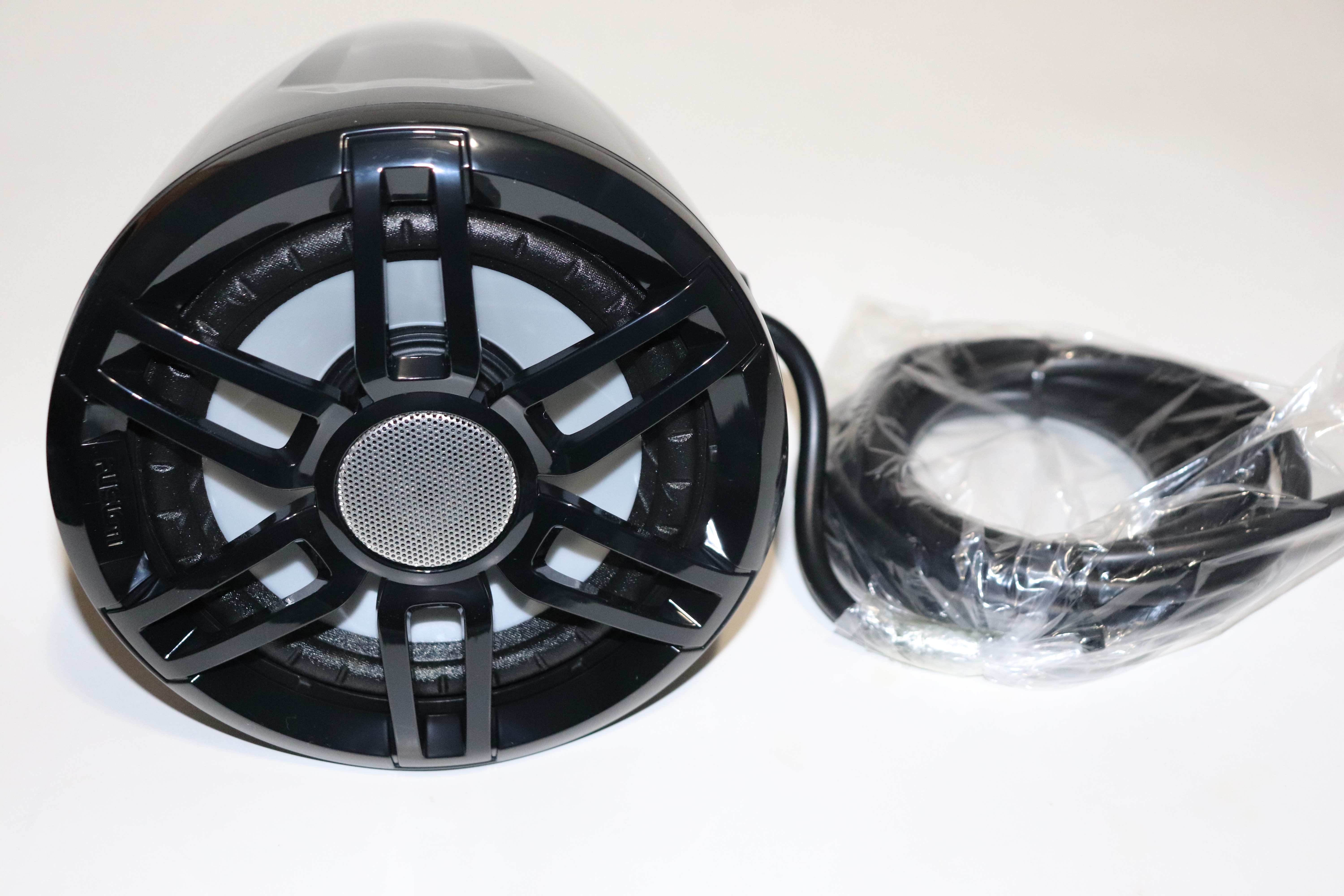
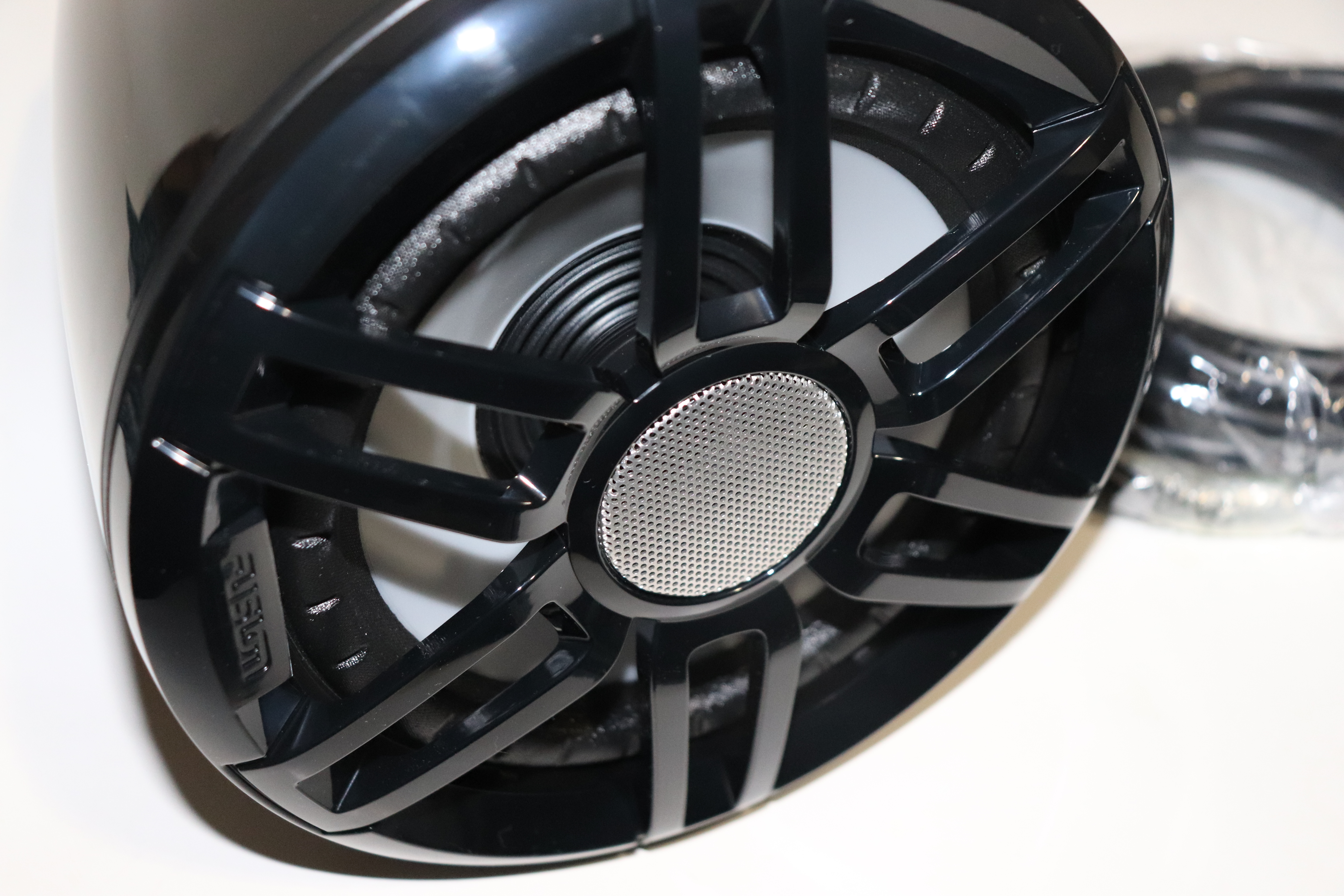
The Garmin Tread Audio System came in a great color printed box with photos of the system. Opening the box revealed a well-protected product held in place by custom sized cardboard. Materials used in the construction was mostly plastic with some metal. Quality of materials used, as well as fit and finish, was excellent. Also included were the adaptors for installation, wire connectors, and owner’s manual.


I really like the design of the Garmin Tread Audio System. It’s an all-in-one system, with a processor/amp, and two tower speakers. The amp processor unit is the brains of the system, and powers the two speakers. There is an app, and through the app and Bluetooth you control the system and use your smartphone for your tunes. It’s all you need.


The amp/processor controls the system, and provides a lot of functionality. It taps into your electrical system with ground and power connectors, and has other connections for the two tower speakers. There are also additional connections for the LED’s. It even has expansion options with line in/out, USB, and an antenna connection for AM/FM radio. Thanks to Bluetooth, all you really need for your tunes is your smartphone. Pull up your favorite music streaming service, or your favorite tunes you have stored on your phone, and you’re good to go.


To set-up the system, you would download the app on your phones. Once you have the app downloaded and your phone paired with the Tread system, you are ready to go. The Tread app is actually pretty simple, almost too simple.  You can select your input, like if you have an antenna, or just using your smartphone.  And then there’s buttons for Zone, Mute, and Volume. The Tread app is also not just for the audio.  There’s a drop-down menu on the top left that allows you to add additional devices, as well as use Group Ride, and Maps.  The Tread app is an app to use with all of their Tread products and not just the Tread Audio System.  I was still a little surprised at the app not including additional audio setting, like an Equalizer and DSP options.


Garmin did a great job with the Tread Audio System. It’s designed to handle the elements it could find itself in, in a side by side. It’s also very durable, being able to handle what you throw at it. The amp processor provides good power for the tower speakers. With a co-axial tweeter and woofer design, the tower speakers also provide great sound, and with the inputs for an antenna for radio, USB, and inputs, you also get great functionality. There’s even wires included in the wiring harness for a second paid of speakers. Using the system, I can see that Garmin succeeded in providing an audio solution for your outdoor vehicle.


I was impressed with the installation. Owner’s/Installation manuals can be hit and miss. Some can be hard to follow, but with Garmin it was well written and easy to follow. The wires were also extremely well labeled. This further increased the ease of installation. Mounting the tower speakers, thanks to the included brackets, was simple. And tapping into the electrical system with the wiring harness, was also pretty straight forward. Now let’s see how it sounds.


Electric Light Orchestra – Mr. Blue Sky: Snaps and drums were nice and dynamic. Vocals were very smooth with good texture of the timbre, and threw a very wide soundstage that also had good depth. Strings were smooth with good resolution of the bow on the strings. Bass also had good depth and played with authority.


Van Halen – Jump: Synthesizer was crisp and clean. Drums were very dynamic with good extension and pitch definition of the midbass. Cymbals were also crisp and clean. Guitar was nice and raw. Vocals were smooth with good timbre.


Rush – Tom Sawyer: Drums were epic, with very good dynamics and good authority, depth and definition of the midbass. Guitar was nice and raw. Vocals were pleasantly smooth with very good resolution. Cymbals were crisp and clean. Soundstage was again nice and wide and with depth.


I was impressed with the sound quality of the Garmin Tread System. They are designed to play loud, mounted on a recreation vehicle, like a side by side, and they delivered that in spades. Yet while being able to play loud, they also provided a very good amount of resolution, and good bass for their size. And a component more thought of with a high-quality home stereo system, they also provided a wide soundstage with good depth as well. While the highs were on the bright side, that can be toned down with equalization.  The LED built into the speakers was also really cool.  I preferred the setting for the lights to adjust to the music.  While Garmin may have a reputation for high quality GPS devices, they have taken that leadership and experience to create other products of the same quality.  As the saying goes….the truth is in the pudding.  And the Garmin Tread Audio System is that pudding.


The Garmin Tread Audio System appeared to be a great audio system on paper. Having used the system, the design proved to be a success. And not only did it sound great, the Garmin Tread Audio System is also very well made, to provide years of audio enjoyment. Garmin is proving that their leadership in great navigation products can transfer to providing other great products as well. If you are in the market for an audio system for your recreation vehicle like a side by side, the Garmin Tread Audio System deserves to be on your short list. Based on its design, features, quality and performance, the Garmin Tread has earned our Editor’s Choice Award. Kudos to Garmin on such a great product. For more info and complete specs, check out their website at www.Garmin.com.


Read more!

Wednesday, May 31, 2023

Nakamichi NDST500A 12 Channel Digital Signal Processor 10 Channel Amplifier Designed for Hi-Res Audio

***Updated. See update towards the bottom of the review.***

Car audio has been around for several generations. But it didn’t really take off until Jim Fosgate invented the first car amplifier in the early 70’s. Back in the day (30-40 years ago), if you wanted the best car cassette deck or CD receiver, it was Nakamichi. They made the best of the best, in sound and build quality. After a hiatus, Nakamichi car audio is back in the US. But is it the high-quality products that gave them the reputation? Time will tell. Up for review today is a DSP with built-in amplifier, the Nakamichi NDST500A.  MSRP is a very fair $1,049.99.


Features and specs:

Dynamic Range (RCA Input):  ≥100dB

S/N (RCA Input):  ≥90dB

THD:  ≤0.05%

Frequency Response:  20Hz~40KHz

Input Impedance:  High Level Input:240Ω

Low level Output Impedance:  51Ω

Signal Input Range:  RCA:  7.5Vpp; High Level: 26Vpp

Signal Output Range:   RCA: 8Vpp;


Amplifier Power

PEAK: 4CH×50W+4CH×80W+2CH×160W, Bridging 1×300W

RMS: 4CH×25W+4CH×40W+2CH×80W


Power    DC9V-16V

REM Input:   High Level Input Signal:H1+/H1-or ACC control cable

REM Output:  +12V Start up Voltage Output

Standby Power:  ≤0.1W

Gross Weight:  Approx. 2.08kg

Product Dimension(L×H×W):  255×175×47mm


TECHNICAL SHEET

Input Type:  6(8) Channel high level, 2 Channel Low Level, External digital Bluetooth, Optical, coaxial

Output Type:  12 Channels low level, 4CH×50W+4CH×80W+2CH×160W, Bridging 1×300W

Output Gain:  Gain range:  Mute, -59.9dB~0.0dB

Output Signal EQ:  31 band Equalizer Engine,

1.Frequency Range: 20Hz~20KHz, 1Hz Accuracy

2.Q value (Slope): 0.404~28.85

3.Gain: -12.0dB~+12.0dB, 0.1dB Accuracy


Output Signal Crossover: Each output is equipped with multi-order high and low pass independent filters.

1.Filtering types: Link-Rill, Butter-W, Bessel

2.Filtering frequency division point:  20Hz~20kHz, Resolution 1Hz

3.Filter slope (Slope) setting: 6dB/Oct to 48dB/Oct and OFF

Output Phase and Time Alignment           

Each output channel can be adjusted for phase and delay, parameter range : phase: in-phase or reverse-phase(0°/180°);

Delay: 0.000 to 20.000 ms, 0 to 692 cm,0 to 273 inch.

Presets  Save 6 presets into the device.


The Nakamichi NDST500A came in a great looking color printed box, with photos and specs of the DSP/amp. Opening the box revealed a well-protected product, held in place by foam. Materials used in the construction was mostly metal, with some plastic. Quality of materials used as well as fit and finish was excellent.  Also included were the wiring harnesses, mounting screws, USB cable, and owner’s manuals.


I really like the design of the Nakamichi NDST500A. It’s an all-in-one design, with both a DSP as well as an amplifier. It’s designed as an all-in-one solution for upgrading your car stereo. No matter if it is totally stock, or an after-market system, the Nakamichi NDST500A will work with it. The one downside, while small, is that it only has two RCA inputs. What that means, is that if you have an aftermarket receiver, you will be limited with the RCA outputs if you want to use them.


The Nakamichi NDST500A is designed to get the best sound possible out of your car stereo system. It starts with the DSP and provides 12 channels of it. And that’s a lot! Each channel is for a single speaker. And for each channel you get crossovers, as well as gains, delays, and EQ’s. This means you have total control of each speaker.  You can set the frequencies that it’ll play, the EQ curve that it’ll play (boosts or dips of frequencies based on your personal preference), as well as the gain or output level that it’ll play. Not only does it work to get the best sound out of your speakers, it also protects your speakers. It does so by feeding each individual speaker only the frequencies that it can play, and at the levels that they can handle.


The next thing that the Nakamichi NDST500A does, is also power your speakers. It does this through the built in amplifier. The built-in amplifier is actually 10 channels. You get 25 watts x4, 40 watts x4, and 80 watts x2 RMS. One small downside it that only the 80 watts x2 channels are bridgeable to 150 watts x1 channel. And the DSP and amp work together.


What does all this mean? For most people, this may be the only DSP and amplifier that you need. Most people in their cars may have a 2-way component system in the front and maybe a 2-way component system in the rear. In that scenario, you would need 4 channels for the fronts, 4 channels for the rears and the last 2 channels of the amp can be bridged to 1 channel for a subwoofer.


But it has 12 channels of DSP, and 10 channels of amplifier power. Why have 2 more channels of DSP? My reference system is a perfect example. My fronts comprise of a tweeter, midrange, and midbass for each side. For the rears I have a tweeter and midrange for each side. And being a bass-head, I need a lot more power to my multiple subwoofers. For my set-up, six of the channels will go to the fronts, four of the channels will go to the rears, and the last two channels of DSP will go to the subs. So for my extensive system, the Nakamichi NDST500A provides all of DSP channels that I need. And for the built-in amplifier, the four channels of 25 watts will go to the four tweeters. The four channels of 40 watts will go to the four midranges. And the final two channels of 80 watts will go to the midbass drivers.


When you think about it, for most people what the Nakamichi NDST500A provides is sufficient. 12 channels of DSP, and 10 channels of amplification should be enough. And when you think about it, 25 watts for a tweeter is usually enough. 40 watts to a midrange is usually enough. And 80 watts to a midbass is also usually enough. And just in case the included amplifier power isn’t enough for you, Nakamichi still has you covered. With 12 channels of DSP, the Nakamichi NDST500A also has 12 RCA outputs. So you can use the 12 RCA outs to go to separate amps. The Nakamichi NDST500A is actually very versatile. It’s a great all-in-one DSP/amp that is all most people will need. But if overkill is not good enough for you, with the 12 channel outs it can be the brains of a really massive system.


In setting up and configuring the Nakamichi NDST500A for my system, the software proved to also be very versatile. There’s a lot to the software, but looking at it everything makes sense and was pretty intuitive. There are the icons for all twelve channels at the top of the page. Clicking on the channel activates it. On the left is an image of a car with images of each speaker and its location. That speaker that is active is also highlighted red. You select the high pass and low pass frequencies, slope, and type of filter. Slope options are 6 to 48 db. There’s also gain, delay, and 31 band EQ. And each band has not just a gain but also a Q, for the width of the slope.  All of these options including the 31 band EQ, are available and adjustable for each channel.


The software looks great, and like I said before, really robust. It helps to really dial in your car’s stereo system. You custom tailor the best sound for your car, and it’s acoustics. It’s very simple to use with your laptop. But there’s also a version of the software for your smartphone. And to test its sound quality, our reference system comprises of a Kenwood Excelon Reference Series receiver, German Maestro’s best M-Line speakers that are hand made in Germany, Alpine Type X speakers, and Image Dynamics subs.  They are excellent audiophile speakers to get every ounce of resolution and details from the music.  Now that it’s installed and configured, let’s see how it sounds.


Nat King Cole – LOVE:  vocals were silky smooth like honey, with excellent texture of the timbre.  Piano sounded very natural, and strings were also very smooth.  Trumpet was not just crisp and clean, but also extremely dynamic!  Trombone also had great tone and harmonics.  Not only was there an excellent level of resolution, I also heard a soundstage that was wide and deep, with excellent imaging.

Dire Straits – Money For Nothing:  vocals were again smooth like Swiss chocolate, with excellent resolution to reveal the great texture of the timbre.   Guitar was nice and raw.  Drums were very dynamic with great pitch definition of the midbass.  This is a song that as soon as you hear the first of the drums kick in…..it just begs to be blasted!  And the Nakamichi provided plenty of power to really play loud, and did so really cleanly!

Cat Stevens – Father & Son: the acoustic guitar was phenomenal! The resolution from the strings was excellent, so crisp and clean. You could even hear the decay of the strings after being plucked.  The vocals were also really smooth with excellent timbre.  And the soundstage was not only deep, the imaging was spot on, being able to hear slight variances as he changed slight direction on the mic.  The drums were nice and dynamic, and the cymbals crisp and clean.

I also listened to dozens of others of my favorite tracks.  And the results were the same.  Vocals were so silky smooth with tons of resolution to really reveal the subtle nuances of the texture of the timbre.  Drums were dynamic, cymbals were crisp and clean, and kick drums had excellent depth, impact, and authority.  Strings were smooth with sufficient resolution to reveal the bow across the strings. Brass was also so smooth with excellent harmonics. Piano sounded natural and also provided good dynamics and harmonics.  I was expecting good imaging and soundstage.  But I wasn’t expecting imaging as good as it was.  And I had not heard a soundstage this big in my system before.  Sure, I had heard tracks throw a wide and deep soundstage.  But there were also tracks where the soundstage seemed to come at me, jumping off of the front dash and come at me, like 3 inches in front of the dash.  That was a first for me!  It seemed as though no matter how good your speakers are, the Nakamichi NDST500A will not be the weak link in your system.   


I had high hopes for the Nakamichi NDST500A. Back in the day, they made some of the best products. Based on the Nakamichi NDST500A, their reputation appears to be intact. It’s a very solid well-made product. The DSP works great, the amplifier provides good power that is not only clean, but also transparent for the source material.  I was a little skeptical at first with the smallish amount of power that each channel was providing, when I first saw the specs.  But then when I really thought about it, the amount of power provided should have been sufficient.  And that proved to be the case.  There was enough power to not only provide very good resolution, but to also provide a great sound stage, imaging, and excellent dynamics!  It’s Nakamichi’s first product designed for and to receive Hi-Res Audio certification.  And the sound quality shows in its performance.


***Update


After the review was completed, Nakamichi sent us their AC2 remote for the Nakamichi NDST500A.  It's an excellent remote, and it does much more than a bass remote like most subwoofer amps provide.  But it could be even more.  Most remotes are just bass remotes, that can increase or decrease the amount of boost for the bass.  Some bass remotes also let you adjust the frequency of the boost, as well as the "Q" or width of the boost.  For the AC2 remote, not only does it adjust the volume of the bass, it allows you to adjust the volume off all channels of the Nakamichi NDST500A.  You just select the channel, and adjust the volume.  


It also allows you to switch between programmed presets.  So just as many audio products will have DSP presets to choose from like Jazz, Rock, Classical, etc, you can do a similat things with presets in the Nakamichi NDSTA500, and switch between those presets with the AC2 remote. What it does not do, is allow you to adjust the subwoofer boost frequency and adjust the Q of the frequency.  Hopefully that functionality can be added to a future version of the remote.  


***   

Kudos to Nakamichi on staying true to their reputation. At least based on this product. Hopefully we’ll be able to continue to see how they perform with more of their products. I just would have liked to see RCA inputs for all channels.  The Nakamichi NDST500A is a great performing product that delivered in spades. And it’s well made to provide years of use. If you want to take your car stereo to the next level, to a fully active system, a product like the Nakamichi NDST500A is a necessity. And it deserves to be on your short list. Based on its design, features, quality, and performance, the Nakamichi NDST500A has earned our Editor’s Choice Award. For more info and complete specs, check out their website at www.nakamichicaraudio.com.  Reference gear used: Kenwood DNX997XR reference series receiver, Wavtech Link 500.1 sub amp, German Maestro M-Line 3-way component speakers, Alpine Type-X 2-way component speakers, Image Dynamic quad ID8 subwoofers.


Read more!